by Steph
[microbadge=45628][microbadge=45628][microbadge=45628][microbadge=45628][microbadge=45628][microbadge=45628][microbadge=45628][microbadge=45628][microbadge=45628][microbadge=45628][microbadge=45628][microbadge=45628][microbadge=45628]
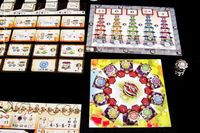
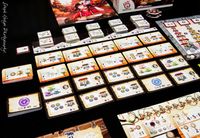
With a new delivery of a couple new games, I was excited to try out Jigūan: The Eastern Mechanist first. New to me!
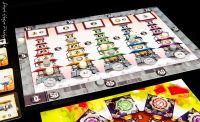
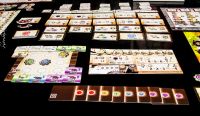
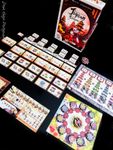
In Jigūan, players are trying to score the most points by creating mechanical beasts to advance on the pagoda tracks and complete bonus cards. The game will end after 2 rounds and all of the machine parts have been taken.
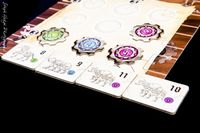
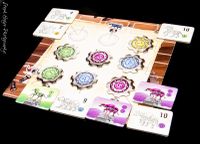
Jigūan has a lot of options with regards to cards and machines, but basically, you can take one of two actions. One action is to take two adjacent gears from the supply board and add them to your workshop. Depending on where you place the gears, you will obtain energy. For example, if you place a yellow gear in a yellow beast’s column or row or diagonal, you will get energy equal to the number of yellow seals. After you place the gears in your workshop, you can purchase a card for an energy cost or purchase a blueprint for a coin cost.
The other action is to create a mechanical beast if you have 3 gears in a column, row, or diagonal that equals the value on the corresponding blueprint. When you create a beast, you will get a card or blueprint reward based on the color of the beast.
What makes Jigūan fun is managing all of the choices you make in this game. You have tons of control and tons of options. You want to optimize your choices for both the mid-game scoring and the end-game scoring.
Michael and I played, and at first, it was a bit overwhelming with the cards and options. Now that we’ve played it, it will be very easy to figure out future strategies.
Since I knew the purple pagoda was scoring at the end of round 1, I wanted to collect all the purple seals I could manage. I even picked up an extra purple scoring card so I would get a few extra points in both rounds. I was pretty heavily focused on purple, which worked well for getting me a lot of energy at times, but it wasn’t ideal for when I needed other colors for scoring.
According to the victory track, I was in the lead all game by quite a few points. Michael would take a turn and catch up a bit, then I would take a turn and jump further ahead. But I had no idea who would win because he was getting a majority of the pagoda points. My extra blueprint points really helped me out at the end of the game, but I still ended up losing 190 to his 192. So close!! Any number of things could have altered that score. What a cool game.
I had a great time playing this one. I loved all of the choices and trying to puzzle out the best solution. This is a real hit for me and one I think will appeal to many gamers. I can’t wait to play this one again really soon!

[microbadge=45628][microbadge=45628][microbadge=45628][microbadge=45628][microbadge=45628][microbadge=45628][microbadge=45628][microbadge=45628][microbadge=45628][microbadge=45628][microbadge=45628][microbadge=45628][microbadge=45628]
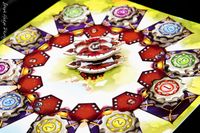
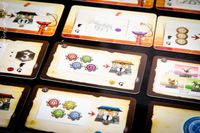
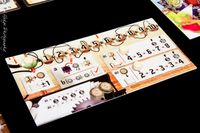
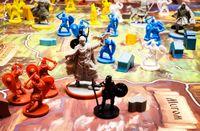
At a recent game day, I was ready to try out a new KS delivery called Rurik: Dawn of Kiev. New to me!
I got a quick demo back at Origins 2018 and it seemed like a really cool game. Although it plays 2 players, I wanted to play with 3 or 4 players since I knew there was a little bit of area control involved.
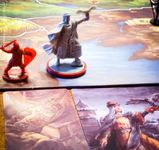
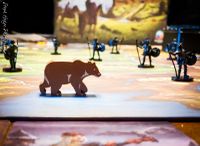
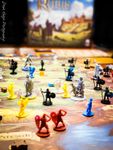
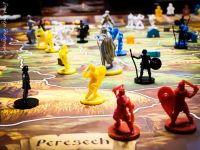
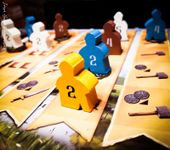
In Rurik, players want to score the most points by advancing on different objective tracks and scoring their hidden goal cards. Each round, players bid for actions they will take in the round. Each worker they bid with will have a basic value, which is also its initiative when resolving that worker. Additional coins can be added to increase the bid value.
Each of the actions will have various levels. For example, if you have the highest bid on the move action, you will get to move any combination of your units up to 4 total spaces. The player who bid the second most will get 3, then 2, and finally the player who bid the least will get only 1 move. Other actions you can bid on include mustering troops to the board, fighting other players and barbarians, taxing locations to gain resources, building structures with various abilities, and scheming to get extra cards. Preferably, you want to have the top space in any action track. Some of the lower spaces cost one or two coins to take even a basic action.
The initiative value is important too. You have to make sure your workers are in the right action spaces so when your number 1 dude is returned to you, you are performing the action you wanted to perform first.
At the end of each round, you will evaluate the map and the resources you have collected and advance on the different tracks depending on what you have accomplished. Fortunately, you never degrade your position on the tracks, even if you spend the resources or lose control of regions.
We played a 4 player game and it took a LONG time to get going. Michael agreed the rulebook was well laid out and pretty good, so that wasn’t an issue at all. It just so happened that we were playing around dinner time, and the host, James, had to order the food, then the food arrived, then everyone stopped to eat. It just wasn’t the most ideal of circumstances. Still, we had a pretty good time playing.
I definitely appreciate the bidding mechanic the most. There is an uncertainty about what will happen with regards to your workers. You might place a 5-value worker in hopes of getting the topmost space for that action, but then every other player can overbid you using coins, and you end up getting the weakest action. The only time you can be sure of your position is when you place the final worker on an action, thereby locking that action. It is such a cool mechanic and I really liked that.
I am less thrilled about the area control aspect. At one point in the game, I was trying to get my troops in different regions. I wanted to claim some honey from one nearby region and maybe muster a guy or 2. No, James totally saw me coming and busted me before I had the chance. He was able to send me to church (converting my troop to his color) before I had the chance to say “Wassup?”. It was rude. :P I suppose that is part of the game and something you should plan on happening.
I still managed to win the game because I collected a bunch of deed cards that gave me 2 points. They weren’t easy to complete, but I still managed to knock them out in the final actions. I was the highest on the warfare track for 3 points because I was the ONLY person to kill another troop. Killing only one of Michael’s troops gave me those VPs. I guess we were just a peaceful bunch. I ended the game with 19 points. Eric was second with 17, James with 14 (personal best!), and Michael with 10. Really not a high scoring game, so every point will matter.
I think our next game of Rurik will flow a lot better, especially if we don’t play during dinner time. This is one I would very much like to play again, and I am thinking it won’t be too bad with 2 players, so I will have to get it played again soon! Cool game.

[microbadge=45628][microbadge=45628][microbadge=45628][microbadge=45628][microbadge=45628][microbadge=45628][microbadge=45628][microbadge=45628][microbadge=45628][microbadge=45628][microbadge=45628][microbadge=45628][microbadge=45628]
I was able to try out the solo variant for a new game called Porto. New to me!
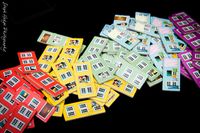
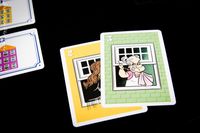
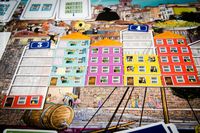
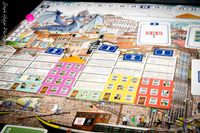
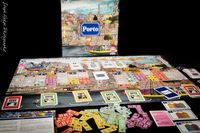
Porto is a city in Portugal, and all of the buildings in Porto are painted in beautiful colors. This game is all about building up the houses and gaining points for it. There are common goals and private goals, but you will gain most of your points by placing floors on the buildings and hopefully completing the buildings for additional points. The person who has the most points will win the game.
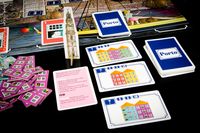
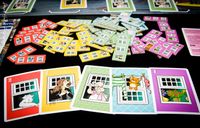
On your turn, you will either draft cards with a total value of 3 from the display, or you will use cards from your hand to place floors in a building. When placing floors, you have to use 2 cards: one card to determine the number of floors you must build and the other card to determine the color of those floors. All floors must be placed in the same building, and if there are existing floors in the building, the new tiles must be the same color.
After you place floors, you will get points equal to the total number of floors in that building. You will also get points for each floor that is directly adjacent to a floor you just built. Roof tiles do not count as floors.
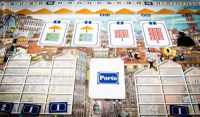
Each building has a point token on the ground floor. When you start a new building, you will score those points and move the point token to an empty roof. When you complete a building, you will place a roof tile and score any point tokens that are there. After your turn is complete, you will score points for any common goals you complete and replace those goals with new cards.
Porto is a pretty light game but can still provide a puzzly challenge. I was playing the solo variant, which gives me 14 turns to score 60 points. I figured it was in my best interest to draw cards, then play those cards the next turn, basically giving me 7 rotations of drawing and building.
After each of my turns, the game automatically draws two cards. These cards are used to build non-scoring buildings. But they help to set me up to gain a lot of points for surrounding buildings and completing buildings.
It all sounds wonderful and easy, but man, it is difficult. I managed to score only 57 points in my first solo game. Yah, I didn’t even win! I was focused on the wrong things and really needed to be focused on what was available to me. It was down to the wire, and there were just not enough points to be had in the final turns. So hard!
Porto was a lot of fun and super easy to learn. I like that I wasn’t able to win the solo game. It only makes me want to play more and actually win! I think Porto is a gorgeous game and it will be great to play with more players as well. I can see how timing is so important since the game end will trigger when enough roofs have been completed. Perfect for casual gamers who like games under an hour.


[microbadge=45628][microbadge=45628][microbadge=45628][microbadge=45628][microbadge=45628][microbadge=45628][microbadge=45628][microbadge=45628][microbadge=45628][microbadge=45628][microbadge=45628][microbadge=45628][microbadge=45628]
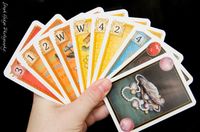
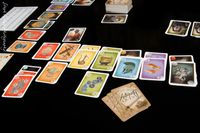
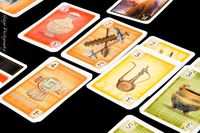
I am always a fan of trying out new card games so I was delighted to learn Antiquity Quest. New to me!
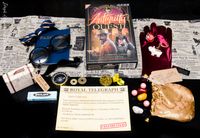
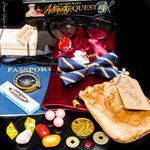
Grandpa Beck outdid himself with this review copy of the game. It came in a box filled with fancy gadgets and knickknacks. I took a bunch of pictures since all of the items really help set the mood for my gaming experience.
Antiquity Quest is based on a card game called Hand and Foot which is a take on Canasta. I hadn’t played Hand and Foot, but I know and enjoy Canasta. There is a variant in the rules for playing with partners, so I can’t wait to play that.
In Antiquity Quest, players are trying to collect and complete sets and get rid of all of their cards. You can play a single round or several rounds, and whoever has the highest score will win.
At the start of the game, players will be dealt a hand of 10 cards and a cache of 10 cards. You can’t look at your cache until your hand of cards has been played and then the cache becomes your new hand. On your turn, you will draw 2 cards from the top of the deck or all the cards in the discard pile. You can take from the discard pile only if you have started at least one set in your tableau and you must be able to use the top card of the discard pile immediately to create a set.
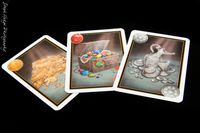
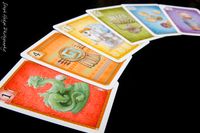
A set must contain 3 cards and a completed set will contain 5 cards. There are different types of sets. A mixed set scores the least but it can hold more than 5 cards. A standard antiquity set contains 5 cards of the same suit, and a standard treasure set contains 5 treasure cards. A perfect antiquity set and a perfect treasure set contain no duplicates and are worth the most points.
You can play on other players incomplete sets, but they will get the points for those cards. However, it might be worth losing that card if you can corrupt a perfect set.
Michael and I ended up playing 2 rounds, one to try the basic gameplay and one to try the advanced gameplay. The basic gameplay is a bit more forgiving. When the basic game comes to an end by one player going out, all other players get another turn. In the advanced game, when a player goes out, other players can play only the cards in their hands and only to their own tableaus. If you haven’t picked up your cache, you won’t be able to. Any cards leftover are worth negative points.
I felt a little more at ease playing the basic version, and I could just do my thing. We would often play full 5-card sets instead of playing 3 cards down because we didn’t want our sets to be spoiled by another player. I had forgotten about the cache cards and didn’t get them until my final turn when Michael went out. I found myself in a similar situation in the second game, but because we were playing the advanced game, I didn’t get that final turn to get my cache cards in hand, so they were all negative points. It ruined me. Needless to say, I won the basic game and lost wicked bad in the advanced game.
Card players will enjoy this one since it has that familiar feeling to classic games. I can play this with anyone and will have a great time. I quite enjoyed it and all of the rainbow colors. I would be happy to play this one again!



[microbadge=45628][microbadge=45628][microbadge=45628][microbadge=45628][microbadge=45628][microbadge=45628][microbadge=45628][microbadge=45628][microbadge=45628][microbadge=45628][microbadge=45628][microbadge=45628][microbadge=45628]
Another new game from EmperorS4 I saw at Gen Con and was itching to play was Trial of the Temples. New to me!
The art in this game just blows me away. I could plaster my walls with artwork from EmperorS4, I love it all! Of course, it makes me even more eager to play their games.
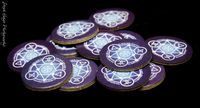
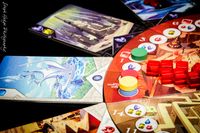
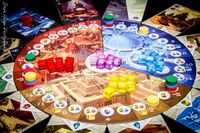
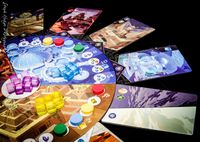
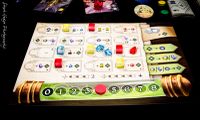
In Trial of the Temples, players are looking to gain the most points by advancing on different temple tracks and gaining bonus points from the spell core placements on their player boards.
The game lasts for 5 rounds, or until the last space on 2 temple tracks has been taken, or there are no purple spell cores remaining. Each round, a special Day-and-Night tile will transition over a number of temple spaces, turning them to the night side, and all of the previous round’s night tiles will turn back to day. Night spaces offer different resources than the day spaces.
In the temple phase, players take turns placing meeples on the different temple locations. In the resource phase, each player will collect all of the resources from the temple they occupy as well as the bottom resources on every unoccupied temple to the left and right.
In the trial phase, players will take turns spending an action token to advance up to 3 spaces in a temple by paying resources. Spaces that are occupied by other players do not count and are skipped over. If a player advances to or past a spell core icon, they will gain the matching spell core and immediately place it on their player board, which will give them an ability or end-game points. If a player runs out of action tokens or resources, they must rest and discard any resources they can’t store.
Michael and I played the 2 player variant and we found it fairly easy to learn. With 2 players, each player will have a clone meeple that they will place on temples can choose to use the clone instead of the player’s meeple by paying a cost. Also, the unused player discs will automatically advance up the temple tracks, enabling the players to advance up the tracks easier. It worked fairly well.
I ended up kicking some major butt since I had all my spell core cubes placed perfectly on my player board, which gained me a bunch of end-game points. I was also near or at the top of the temple tracks, so that scored me a bunch of points.
The rules are simple and the gameplay is pretty streamlined. I feel like this could be a nice step up from Splendor-type games for new players. Since it is so gorgeous, it should be easy to find players to play. The 2-player rules are a bit different, so I look forward to playing again with more players. Very enjoyable game!


[microbadge=45628][microbadge=45628][microbadge=45628][microbadge=45628][microbadge=45628][microbadge=45628][microbadge=45628][microbadge=45628][microbadge=45628][microbadge=45628][microbadge=45628][microbadge=45628][microbadge=45628]
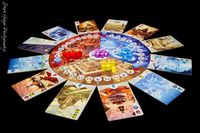
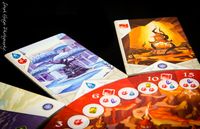
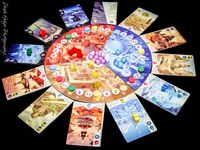
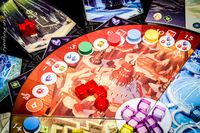
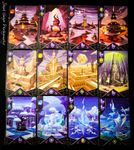
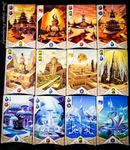
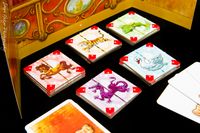
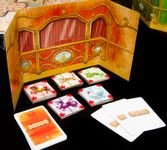
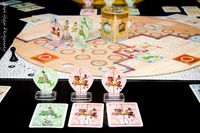
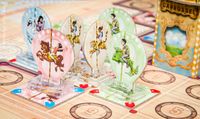
Another new release I played recently was Carrossel. New to me!
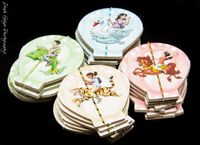
This game has an adorable cover that made me want to play it. I love the theme and the memories that surface. My mind immediately thinks of Mary Poppins and my childhood. How could I not want to play this game with that in mind?
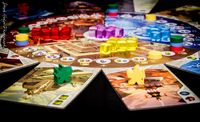
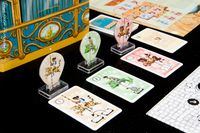
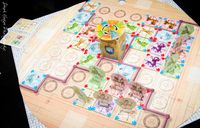
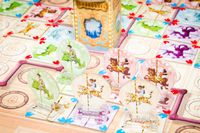
Carrossel is an abstract tile-placement game where you are trying to create patterns on the board to scorecards for victory points. The player with the most points when the draw deck runs out is the winner!
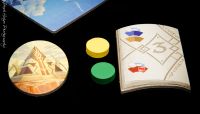
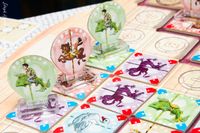
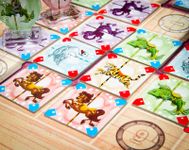
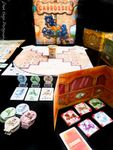
During set up, each player is given a set of tiles and their own deck of numbered cards, 1-12. Each turn, players simultaneously select a numbered card and a tile, then everyone reveals simultaneously. The numbered card specifies where the tile will be placed on the board in the region that is currently in front of them. That card will remain face up in front of that player and cannot be used in subsequent rounds.
Next, each player will evaluate their region for a color pattern that matches the tickets in front of them. For example, I might have a Blue, Green, Green set of tickets in front of me. If those tiles exist in any combination, in a row and without riders, and at least one tile is in my region, then it will score. A rider pawn is placed on each of those tiles and the players that own those tiles will get the corresponding tickets. Each of the ticket cards has a special ability that can be used only once.
When placing tiles, you want to be aware of the surrounding tiles and the patterns you are creating. There are end-game goal cards that every player will score, so you want to complete as many of those goals as you can.
This game works a bit differently with 2 players. Each player controls 2 regions and will be placing 2 tiles using one numbered card, which can be a bit more strategic.
During my play with Michael, I was having a hard time scoring my cards. I was trying to set up for too many possible scorings and it just ended up hurting me. He was able to score twice near the ending, and I was unfocused and couldn’t score anything. I managed to catch up with the end-game scoring cards, but it wasn't enough. He ended up winning 32 to my 28. So it was still a pretty close game in the end.
It will be interesting to play this with more players. It will probably be easier to only have to deal with one region a turn, but it might be harder to evaluate what other people are doing so you can figure out how to optimize your tiles. Beautiful game and simple to play and learn, so it’s a great choice for families and casual gamers.
[microbadge=45628][microbadge=45628][microbadge=45628][microbadge=45628][microbadge=45628][microbadge=45628][microbadge=45628][microbadge=45628][microbadge=45628][microbadge=45628][microbadge=45628][microbadge=45628][microbadge=45628]
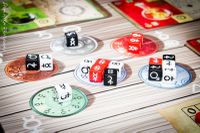
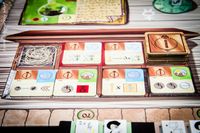
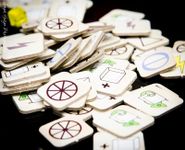
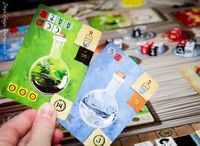
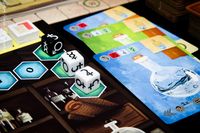
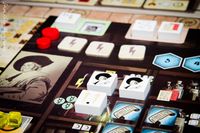
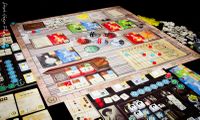
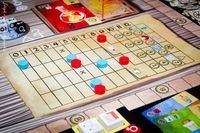
Perhaps the heaviest and most complicated game I have ever personally learned the rules for by reading the rulebook is Trismegistus: The Ultimate Formula. New to me!
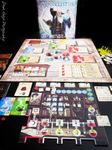
Trismegistus is a beast of a game. If I tried to get into too much detail about the gameplay, this blog would go on for days. So, I will give you the shortened version. You are trying to score the most points by completing experiments and creating your Philosopher's Stone (no relation to Harry Potter, sadly).
Over 3 rounds, players will draft dice that they will use to collect materials and essences. These dice will also be used to gain artifacts and experiment cards. The color of the die matters for transmuting your materials to better ones. When you transmute a material, you must spend an essence and you will advance on the corresponding essence track.
You can complete an experiment as soon as you have collected the appropriate materials and have advanced far enough along the corresponding essence track. Experiments give an immediate bonus and end-of-game points. The first time you complete an experiment of a given type, you will unlock a formula. Formulas will help complete the Philosopher's Stone and will gain you one-time bonuses.
Everything is interlocking and complex.
I am typically not the one who reads the rules when I play games. But I was very interested in playing this one so I thought I would get a jump on it by reading the rules. #mistakesweremade The rulebook is long and complicated and wordy. There is a very poor flow to it and has several instances of ambiguity. I mean, it took me 2+ hours to get through the setup and learning how to play. I swear I am not daft - it shouldn't have been that difficult.
The first playthrough was rough going. Michael learned how to play and we worked through it. We had to reference the rules a lot during the game. There should really be a better player aid of the different options available to you.
I had no real focus in mind. I collected a lot of different things which lead to me getting more things. I worked with what the board was giving me at the time it was giving it to me. I was finding patterns and good opportunities. Michael was not having the luck I seemed to be having. Perhaps he was too focused on the cards he was given at the start of the game and it made him lose sight of the opportunities on the board - it is hard to say. There is a lot happening at any given time and the options are vast.
Michael felt there was nothing he could do to catch up, but he still played his best until the end. In the end I doubled his score with 236 to his 116.
All in all, this game won't come easily to many gamers, even to those who love heavy games. It will be a beast to teach and even harder without a good player aid explaining the various actions. It is hard to recall everything you can do on your turn. Experienced gamers will always have an advantage over those who haven't played the game before. But I think there is a lot of potential here.
At the end of the day, I enjoyed playing Trismegistus, even if it was less than perfect with all of the rules issues. However, I doubt I will frequently play it due to its complexity. Teo is much easier, IMO. Tris is far more abstract in how you have to think throughout the game. It will be interesting to see how people respond to this one. I want to play again with people who already know and enjoy the game and I think that will help me to like it more.
[ImageID=4967868 medium rep]
[microbadge=45628][microbadge=45628][microbadge=45628][microbadge=45628][microbadge=45628][microbadge=45628][microbadge=45628][microbadge=45628][microbadge=45628][microbadge=45628][microbadge=45628][microbadge=45628][microbadge=45628]
New to the Collection:
Castello Methoni
Prêt-à-Porter
BEERU and Sausages
Cha dango
In Full Bloom
Bloom Town
Thanks for following along!
Happy Gaming!!!
-Steph


All images in this post are copyrighted, owned, and controlled by Steph Hodge Photography, unless otherwise noted.
Please contact me if you would like to purchase or use my images in any way.
Thank you.
![Grey Streak, Roscoe Fox – Faith in One City 2008 (2026) [24-bit FLAC]](http://imageurl.xyz/images/2026/07/07/Grey_Streak-Faith_in_One_City_2008-NSR031-24BIT-WEB-FLAC-2026-ENRiCH.jpg)


/pic9691115.jpg)